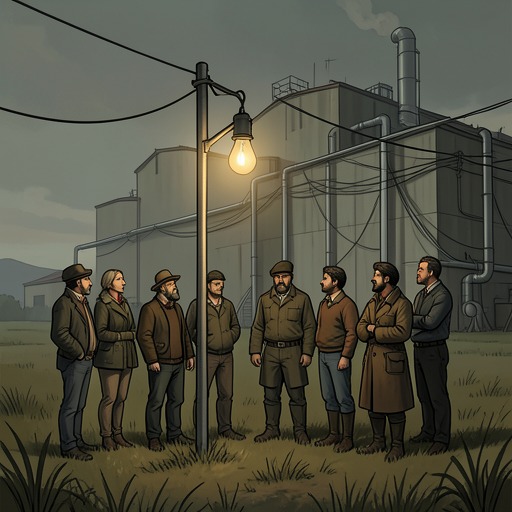
“We can go back to the soil all right—but on other planets.”
The Caves of Steel“We can go back to the soil all right—but on other planets” is Elijah Baley’s proposed bridge between Medievalism and space colonization. By turning a slogan of return into an argument for leaving Earth, he imagines a way to enlist the movement in the Spacers’ larger project—and reveals that he has come to share that project himself.
The Slogan Recast
Baley presents the phrase while pressing the Commissioner to cooperate with the Spacers. He argues that the Commissioner must hold a powerful position in New York’s Medievalist organization, perhaps even in its wider planetary structure, and urges him to steer its influence toward colonization. The line preserves the emotional pull of Medievalism’s return-to-the-soil ideal, but relocates its destination: the soil can be recovered on other planets.
The force of the formulation lies in its reversal. Rather than simply dismissing Medievalist longing as backward-looking, Baley translates it into a program that points outward. The familiar ideal becomes propaganda for the resumption of Galactic colonization, making cultural language a possible instrument of political change.
Stakes in the Conversation
The Commissioner responds with confusion, and Baley explains why the proposal matters to the Spacers. They want colonization above all; their repeated journeys to Earth expose them to the risk of death in pursuit of that purpose. Baley asks the Commissioner to consider whether, if Dr. Sarton’s murder could help bring Medievalism into line with renewed colonization, the Spacers might regard that sacrifice as worthwhile.
That argument does not make the murder harmless or establish the Commissioner’s agreement. Instead, it places the case within a conflict larger than prosecution: the possibility that a death could alter the political direction of a movement and help reopen the path from Earth to the stars.
Baley’s Changed Position
Baley makes the phrase personal as well as strategic. He says that he too now wants what the Spacers want, attributing the change to a conversation with Dr. Fastolfe. The line therefore marks a shift in his understanding of the investigation: colonization has become more than the Spacers’ objective, and the slogan supplies a concise expression of the shared future he has begun to imagine.
Its significance rests on that double movement. The words offer the Commissioner a tactic—redirect Medievalist influence—while exposing Baley’s own changed allegiance to the goal behind it. A promise of returning to the soil is not discarded; it is made compatible with a future on other worlds.